Introduction of Roller conveyors
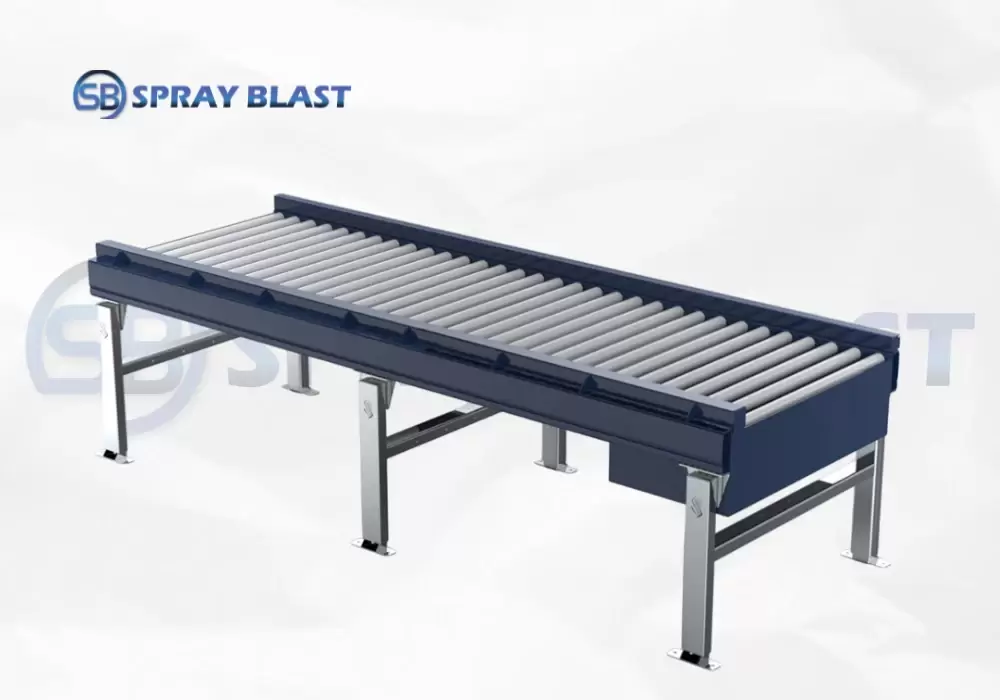
Roller conveyors are the most versatile and adaptable conveyors. These are utilized for warehousing, supply chain management, inventory control, abrasive shot blasting machine, and cargo handling, and are incredibly cost-effective. It makes it possible for frequently utilized cargo shipments to be transported very swiftly and effectively. It is widely utilized in locations with motorized segments or gravity effects for extended schedules, complex configurations, or sophisticated setups. It can be moved manually or with power using rollers fixed on frames. Its cost-effectiveness, simplicity, and modularity make it widely used. Completely revised software system with mechanical and electrical setup in response to current and future demands. Its operating system is user-friendly and has a touchscreen. Roller conveyors are used to smoothly transport workpieces through the shot blasting room.
Types of Roller conveyors
Roller conveyors are classified into four groups.
Gravity Roller Conveyors
Gravity roller conveyors are the most cost-effective and straightforward method of conveying products. This is a non-powered conveyor system. It transports the material using gravity and a set of rollers. It is only used for material that is horizontal or slightly inclined towards the rollers. It offers versatility and modular configurations. It was most commonly used as an alternative to skate wheel conveyors in heavy-duty material, abrasive blasting machines, and cargo handling applications. Because of this, workflow balance is maintained while processing time is reduced in industrial manufacturing facilities.
- The standard rollers are zinc-plated.
- It comes in both light and medium duty models.
- On the inner side guards, 50-60mm diameter steel rollers with a pitch area of 75mm are attached.
- Gravity Bend is a 'Z'-section structure.
- On the gravity roller table, plastic free-running rollers are accessible.
- The table's tracks can be steel or aluminum.
- The space between roller centers varies depending on the application. Normal space measures 3", 4.5", and 6".
- Frames are often made of powder-coated steel or aluminum
- Roller pitch ranges from 75mm to 150mm.
- Conveyor frame width ranges from 300mm to 1200mm.
- The incline angle is usually 3-5 degrees.
- The bearing housing contains and protects the bearings within the rollers. It can be composed of steel and plastics.
- Idler rollers are a cylindrical structure that rotates freely and supports the conveyor belt. These are made of steel, nylon, and PVC.
Line Shaft Roller Conveyors
Line shaft roller conveyors are motorized roller conveyors. It employs a shaft that rotates constantly. The shaft is attached to the conveyor's framework. The belts that connect the shaft to individual rollers are known as drive spools and elastic polyurethane o-rings or belts. These belts work to smooth the movement of light or medium-weight materials. An electric motor that is typically controlled by a programmable logic controller (PLC). It spins the line shaft by allowing coexisting movement along long and curved conveyors without the use of separate chains, complex mechanical couplings, or separate drives.
- Lineshaft operated by an electric motor with a 25mm diameter.
- Rollers with diameters ranging from 1.5" to 2.5" are made of steel, aluminum, or PVC.
- Polyurethane o-rings (3-5mm);
- Roller frame made of powder-coated or galvanized steel.
- 0.25-1.5HP motor, 230V/450V, 3-phase or 24DC for modular system.
- Roller diameters: 38mm and 50mm.
- Roller materials are commonly galvanized, stainless steel, or aluminum
Motor-driven roller Conveyors:
MDRs are powered roller conveyors. It employs a low-voltage (24V DC) motor that is integrated within the roller shafts. These systems are modular with minimal energy consumption. Poly-V or Poly-O rings are used to power adjacent passive rollers. These conveyors are highly flexible, simple to use and install, and excel in accumulation and transfer applications in e-commerce, postal, and high-volume distribution systems. These are quiet to operate, modularly scalable, energy-efficient, and require little maintenance.
- Idler rollers, also known as slave rollers, are not powered rollers. It revolves via a mechanical linkage from MDR. It's handy for transporting smooth materials.
- Zonal control boards are used to manage MDR. It accepts signals from sensors and routes them to higher-level controllers or PLCs.
- The roller frame can be steel or aluminum in any shape, such as curved or inclined.;
- A single power unit supplied low-voltage power (24V).
- The load capacity should be 35-75 kg per roller.
- Roller diameters range from 1.9" to 2.5".
- Roller pitch: 75mm to 150mm.
- Drive zone length: 500mm to 1500mm.
Flexible roller conveyors
Flexible roller conveyors are simple to use, portable, expandable, and multifunctional material handling systems. These conveyors allow for the smooth and effective movement or transfer of heavy cargo. The rollers in this system can move freely and adapt to various layouts and requirements. These can be customized in a variety of shapes and sizes.
Flexible Roller Conveyor
It is dependent on either hand pushing or gravity. It is simple to use manpower to quickly load and unload logistics from one location to another. It's useful for truck loading and unloading.;
- The length of the conveyor frame varies, largely depending on the module. Individual modules can be 1.5 meters long and stretched to 20 meters or more.
- The conveyor frame width varies from 500mm to 700mm.
- Speed up to 30 meters per minute or somewhat higher.
- Load capacity up to 200 pounds per foot. It can support the maximum weight.
- Heavy-duty material, 125mmx36mm spin for maximum action.
- Height adjustment feature.
Powered Flexible Roller Conveyors
These conveyors include powered/motorized rollers, allowing them to efficiently regulate the movement of heavy-duty products over extended distances. It is great for loading and unloading vehicles safely and quickly.
- Roller diameter up to 50mm.
- The roller material is galvanized steel.
- Roller spacing can be adjusted to maximum pitches of 67mm or 102mm.
- To ensure longevity and strength, the conveyor frame is largely made of bolted steel that is not rooted.
- Conveyor frame widths according to various specifications include 460, 600, 750, and 900 mm.
- The conveyor frame length can be expanded to any desired length, with a maximum pitch of 130mm.
- Heavy-duty cloches might measure 160mm x 50mm.
- The load capacity can be up to 250kg per meter.
- Speed is adjustable, typically ranging from 6 to 35m/min.
- Power can be three-phase 380V or single-phase 240V.
- Drive belts may employ high-tension urethane O-rings for transmission.
- Side guards and plates are composed of a bright zinc-plated steel plate.
Roller Conveyors Manufacturer in India
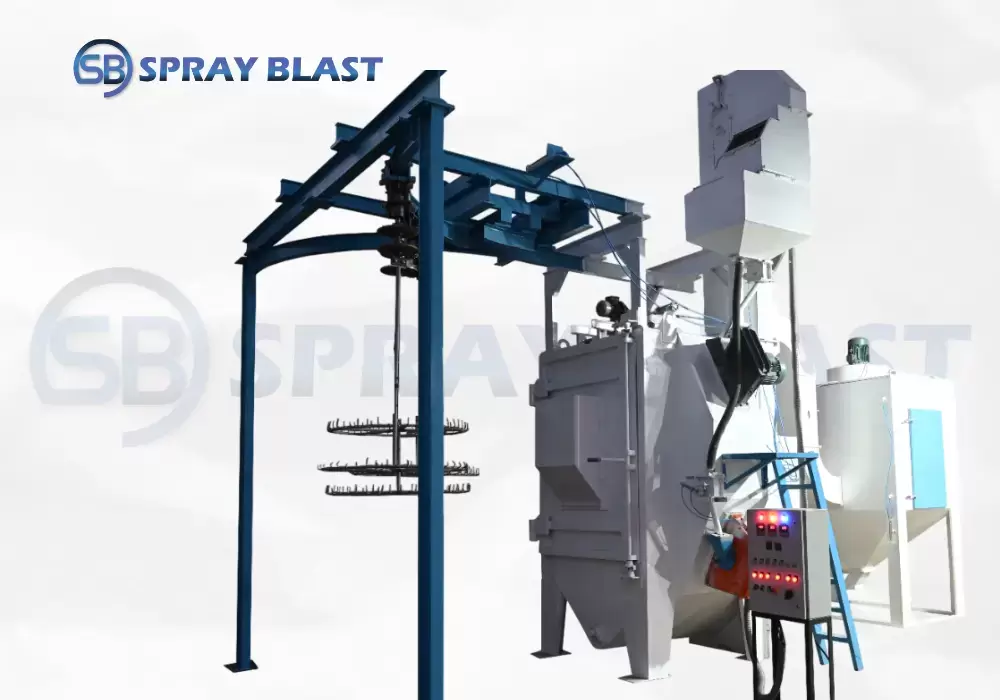
Spray Blast is the leading industrial roller conveyor manufacturer in India and also a roller conveyor system supplier worldwide. Roller conveyor price depends on the type of roller conveyor system. We also offer all types of abrasive blasting machines, sand blasting machines, roller conveyor shot blasting machines, pipe shot blasting machines, diabola shot blasting machine, sand blasting rooms, sand blasting cabinets, granite engraving machines, vacuum blasting machines, thermal spray guns, abrasive media, etc.